The boundary between material and immaterial
The Blazing WorldThe boundary between material and immaterial in The Blazing-World is not a stable wall between two self-sufficient realms. The Empress’s inquiries repeatedly test whether spirits and souls can act or know without bodies, and the answers make material vehicles indispensable to spiritual motion and sensation. At the same time, the Duchess of Newcastle’s soul crosses worlds while her body stays behind, and the mind is said to create an immaterial world of its own. The result is a sustained inquiry into dependence and difference: immaterial beings may be bodiless in nature, but their activity, knowledge, and relation to a world remain entangled with matter.
Nature as Self-Moving Matter
The Empress’s account of natural philosophy gives matter the work commonly assigned to an independent spiritual mover. Addressing the Ape-men after disputes over whether natural bodies derive from elements, water, or the three chymical principles of salt, sulphur, and mercury, she rejects the search for primary ingredients. Nature, she argues, is one infinite self-moving body, divided into parts that continually change through composition and division. Self-moving matter is the universal principle and cause of natural effects; fire, by contrast, is only a particular creature of Nature and cannot disclose the principles of every body. Her example is gold, whose interior figure fire has not been able to change. The material world is therefore not inert stuff awaiting an immaterial cause: motion and transformation belong to Nature itself.
The spirits’ later explanations preserve that priority of matter even when the subject turns to immaterial beings. Asked whether they give motion to natural bodies, they say the reverse: material bodies give motion to spirits. Pure spirits, being incorporeal, are immovable; they move through corporeal vehicles, and their apparent speed at great distances is attributed to vehicles made of matter that is especially pure, rare, and light. The spirits also deny that they can speak without bodily organs or possess bodily senses without a body. They distinguish this from supernatural knowledge, which they say they can have without a body, but deny that created spirits possess general or absolute knowledge. Such knowledge belongs to God alone.
This account does not make the vehicle a disposable shell. The spirits say they cannot leave their vehicles because, being incorporeal, they cannot quit them; instead, the vehicles change into different forms and figures as circumstances require. Those vehicles are themselves living, self-moving bodies, and the spirits agree with the Empress’s inference that such a body gives motion to the spirit it carries. The relation is thus asymmetrical but intimate: the spirit is not the body’s motor, yet its movement in the world depends on its material vehicle.
Souls, Bodies, and Natural Life
The conversation extends the same problem to human souls. The spirits do not claim knowledge of the origin of human souls, but they argue that bodies make souls active by giving them motion. They also question whether a soul must choose its body: when a soul parts from one body, they say, it enters another, since a soul without motion of its own must be embodied in the nearest parts of matter. The discussion does not settle every consequence of this claim. Asked whether all matter is ensouled, the spirits say they cannot tell exactly, and frame the possibility conditionally: if all matter moves only through spiritual power, yet all matter is moving, a soul leaving one body would have to enter another ensouled body.
The spirits nevertheless draw a sharp distinction between immaterial and material souls. Two immaterial souls cannot occupy one body, they say, because bodiless beings have neither parts nor place. But a composed body may contain numerous material souls, since every material part has its own natural soul. They describe Nature as a single infinite, self-moving, living, self-knowing body composed of inanimate, sensitive, and rational matter intermingled throughout: sensitive matter is life, rational matter is soul, and inanimate matter is body. No part of Nature, not even an atom, lacks any of these degrees. This account makes life and soul present within material composition rather than importing them from a separate, purely spiritual realm.
The exchange further denies that natural life and form can be detached from matter to constitute an independent world. The spirits say that immaterial spirits cannot properly make a world, because a world belongs to material creatures. Nor, they add, can there be a world of matter without lives and forms: natural lives and forms cannot be immaterial any more than matter can be immovable. Matter, life, and form are inseparable in Nature. The claim distinguishes a supernatural or spiritual order from a natural world without allowing natural existence to be split into lifeless matter on one side and immaterial life on the other.
Limits of Spiritual Knowledge
The Empress’s questions also expose the limits of the spirits’ authority. At one point they acknowledge that they do not know whether human souls were all made at the world’s first creation, and they decline to explain where the first disobedient sin came from. Elsewhere, their knowledge proves explicitly dependent on memory. They admit they have forgotten whom Ben Jonson meant by the Druggist in The Alchymist, explaining that what is past is retained only if it is recorded. They describe foreknowledge not as unmediated access to the future but as prudent observation: they compare past and present actions to anticipate what may come.
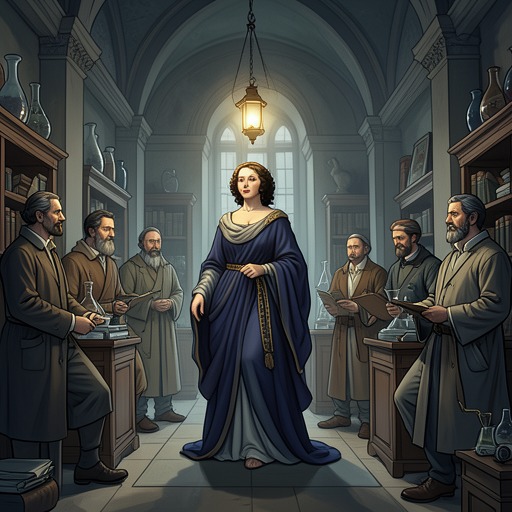
This fallibility matters because the spirits are repeatedly consulted about realities that exceed ordinary perception. When the Empress asks to make a Jewish Cabbala, they disappear immediately. She falls into a trance and, after reflection, supposes that they may have been punished for errors in their answers and sent into the earth’s darkest vehicles. Her distress is not merely at their vanishing: she fears that her request has caused harmless spirits to suffer. The Worm-men comfort her by describing the earth as warm, fruitful, quiet, safe, and inhabited by creatures who see by its own light. She then sends the Worm-men downward and the Fly-men upward to search for the spirits. The episode makes the distinction between material and immaterial inseparable from uncertainty: the Empress cannot simply see where the spirits have gone or know their condition, and must enlist embodied observers to investigate.
The Duchess of Newcastle’s soul later offers a direct caution against treating spirits as universal authorities. When the Empress wants to compose a Cabbala, the Duchess advises her that created spirits, like mortals, lack general or absolute knowledge and cannot know human thoughts or the Creator’s mysteries unless divine knowledge is granted to them. She recommends leaving the work aside rather than risking error. The advice qualifies the spirits’ testimony from within the narrative: their accounts of vehicles, souls, and knowledge are consequential, but neither their supernatural status nor their access to other worlds makes them omniscient.
Crossing Worlds: Soul, Body, and Matter
The Duchess’s visit gives the distinction between material and immaterial a narrative form. The Empress summons the Duchess of Newcastle’s soul to serve as her scribe, and the soul arrives to wait upon her; their spiritual meeting is described as an embrace and kiss. The Duchess’s bodily self, however, remains in her native world. The Empress and the Duchess’s soul can converse across worlds, while the material benefits they discuss cannot cross with them. The Duchess says that matter cannot travel as souls and spirits do, and that even the natural elixir of the Blazing-World would not have prolonged her soul’s life as it might a body, since souls are unalterable.
That distinction shapes their talk about wealth and affection. The Empress says she has not enriched her own family because gold and riches make people covetous and drive them to destroy one another; more wealth, in her view, only enlarges an appetite that is already infinite. The Duchess’s soul says she would want riches for her lord and his posterity, not for herself, and asks instead for the life-preserving elixir, if a passage between worlds could be found. The Empress promises to order the Fish-men to search for such a passage and says that, if one existed, she would make the Duchess as powerful a monarchess as herself. The offer reveals both the reach and the limit of the Empress’s power: she can command an expedition and imagine a transfer of material goods, but she cannot make matter cross the divide merely by willing it.
The return makes that limit tangible. After the Empress arrives back in the Blazing-World, the Emperor welcomes her with the same intensity of affection she has for him. The Duchess’s soul asks leave to return to her noble lord, and the Emperor first shows her the stables and riding houses he has built during the Empress’s absence. A double stable holds a hundred horses on each side; its gold structure is lined with precious materials, with an agate roof, carnelian walls, an amber floor, mother-of-pearl mangers, crystal pillars, and a turquoise gate. The riding house is lined with sapphires and topazes and floored with finely sifted golden sand. These material magnificences impress the Duchess’s soul, but cannot be carried to her husband’s world. She later tells him that, if a passage existed, he could have the horses and building materials; without one, the two worlds remain materially separate even when their inhabitants are joined by affection and report.
Imagination and the Limits of Possession
The spirits redirect the Duchess’s desire for worldly sovereignty toward creation within the mind. When she asks about becoming empress of one of the numerous other worlds, they answer that those worlds are inhabited and governed, and warn that conquerors often fail to enjoy their conquests because they are more feared than loved. They propose instead that every human creature can create an immaterial world within the head or skull, populated by immaterial subjects and fashioned with whatever motions, forms, colours, perceptions, and government the creator chooses. Such a world can be altered at will, even changed from natural to artificial. The contrast is not simply between an inferior material realm and a superior spiritual one: a monarch of a material world bears the general trouble of rule but can enjoy only particular parts, whereas an imagined world can be shaped and revisited without material travel or political opposition.
The Duchess’s soul’s later conversation with the Emperor extends this imaginative freedom into literary form. Asked to advise on a theatre, she distinguishes natural descriptions of human humours, actions, and fortunes from plays constrained by artificial rules. The Emperor wants plays that make wise people and insists on natural rather than artificial descriptions; the Duchess proposes that her plays might be performed in the Blazing-World even if they cannot be staged in the so-called Blinking-World of Wit. Her distinction echoes the larger inquiry: a created form need not imitate an external material arrangement to have coherence or value. The mind can fashion worlds, while art can shape natural human experience according to a different principle than the prevailing mode.
After the Duchess’s soul returns to its body, she recounts the Empress’s travels and the subjection of monarchs to tribute, as well as the splendour of the Emperor’s buildings and horses. The report carries knowledge across the divide, but not the things themselves. Her husband answers that there is no passage between the worlds and that obstruction has always attended his good fortunes. The ending thus preserves both connection and separation: the soul can visit, converse, and bring back accounts, while bodies, riches, horses, and the elixir remain bound to their own material world. The boundary between material and immaterial is permeable to relation and imagination, but not to every form of movement or possession.